
Why Businesses Are Choosing Paxton Access Control Systems

Businesses today need more than locked doors and physical keys. Commercial properties often require stronger oversight, faster credential management, and better visibility into who can access specific areas.
As organizations grow, traditional key systems can become difficult to manage. Lost keys, employee turnover, vendor access, and multi-site operations can create security gaps and administrative challenges.
Modern access control systems help businesses improve control over facility access while supporting daily operations more efficiently. One platform frequently used in commercial environments is Paxton.
What Is Paxton Access Control?
Paxton is an electronic access control platform designed for commercial and institutional facilities. The system allows businesses to manage building access electronically using credentials such as cards, fobs, PIN codes, or mobile devices.
Paxton solutions are commonly used in:
- Office buildings
- Retail environments
- Healthcare facilities
- Educational campuses
- Commercial property management
- Multi-tenant buildings
The platform is designed to help organizations manage access permissions while simplifying administration across one or multiple locations.
Why Businesses Consider Paxton
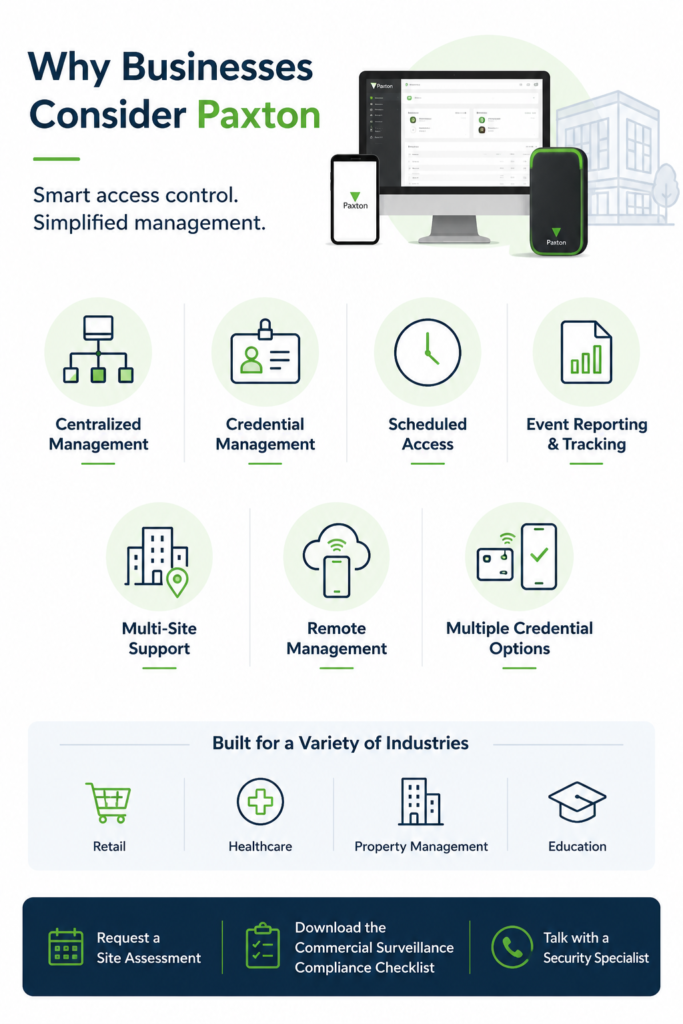
Many organizations choose Paxton because the platform is designed to balance usability, scalability, and centralized management for commercial environments. As businesses grow, managing employee access, vendor entry, and multiple facilities can become increasingly difficult with traditional key systems.
Paxton access control systems help businesses simplify access management while improving operational visibility and flexibility. The platform is commonly used in offices, retail locations, healthcare facilities, educational campuses, and multi-site commercial properties.
Some commonly used Paxton capabilities include:
- Centralized management of doors and user permissions
- Credential management for employees, vendors, and contractors
- Scheduled access based on time and day
- Event reporting and activity tracking
- Support for multiple facility locations
- Remote management capabilities
- Compatibility with card, fob, and mobile credentials
Centralized management can help businesses oversee multiple entry points from a single system, while electronic credential management allows administrators to quickly update or revoke access when staffing changes occur.
For organizations with multiple properties or remote operations, Paxton’s remote management features may improve efficiency by allowing administrators to manage access without being onsite. Compatibility with mobile credentials and traditional access methods also provides flexibility for businesses modernizing their security infrastructure.
For companies transitioning away from traditional key systems, electronic access management can offer a more streamlined and adaptable approach to commercial security.
Supporting Multi-Site and Growing Operations
Businesses with multiple locations often face additional security management challenges. Managing credentials separately at each facility can create inefficiencies and increase administrative overhead.
Paxton systems can help organizations centralize access management across multiple properties or departments. This may allow facility managers and operations teams to:
- Add or remove users more efficiently
- Standardize access permissions
- Monitor activity from multiple locations
- Reduce dependency on physical key distribution
- Improve response time when credentials need to be revoked
For growing organizations, scalability can be an important consideration when selecting an access control platform.
Paxton and Integrated Security Systems
Access control systems are often more effective when integrated with other security technologies.
Many businesses combine access control with:
- Commercial surveillance systems
- Alarm monitoring systems
- Visitor management processes
- Remote security management tools
When systems work together, organizations may gain better visibility into security events and improve coordination across facilities.
For example, combining video surveillance with access control may help businesses review entry activity alongside recorded footage when investigating incidents or monitoring restricted areas.
Common Situations Where Access Control Helps
Different industries use access control for different operational reasons.
Examples include:
Property Management
Property managers may use access control to manage shared facilities, maintenance access, leasing offices, and tenant entry points.
Healthcare Facilities
Healthcare environments often require restricted access to medication storage areas, records rooms, staff-only areas, or after-hours entry points.
Retail Businesses
Retail operators may use access control to secure stockrooms, offices, receiving areas, and cash handling locations.
Educational Facilities
Schools and campuses may use access control to manage staff entry, classroom access, administrative offices, and visitor restrictions.
Considerations Before Implementing a Paxton System
Before selecting or upgrading an access control system, businesses should evaluate several operational factors.
These may include:
- Number of doors and users
- Existing infrastructure
- Future expansion plans
- Remote management needs
- Compliance or reporting requirements
- Integration goals with cameras or alarms
- Visitor and vendor access procedures
A facility assessment can help organizations determine the most practical system design based on operational requirements and security priorities.
Planning for Long-Term Security Management
Access control systems are often part of a broader long-term security strategy.
Businesses that invest in scalable systems may be better positioned to adapt as operations change over time. This can include adding locations, adjusting staffing structures, expanding surveillance coverage, or integrating additional security technologies.
Long-term planning can also help reduce operational disruptions associated with disconnected or outdated systems.
Commercial Access Control Installation and Security Assessment
Need help evaluating access control options for your facility? American Safe Inc. provides commercial security integration services for businesses throughout Northern California.
Request a site assessment, download the Commercial Surveillance Compliance Checklist, or speak with a security specialist to discuss access control, surveillance, alarm integration, and key management solutions.
Key Takeaways
- Paxton access control systems help businesses move beyond traditional key management.
- Electronic credentials can simplify employee, vendor, and multi-site access administration.
- Centralized management may improve visibility across commercial facilities.
- Paxton systems can integrate with surveillance and alarm technologies.
- Scalable access control infrastructure can support long-term operational growth.
- Different industries use access control to support security, compliance, and operational oversight.