Cash Handling Security: Adding an Extra Layer for Your Business

As a business owner, you have a lot to protect, and not just cash. It might be high-value inventory, tools, electronics, sensitive records, controlled products, or simply the ability to open tomorrow without disruption. Most owners already have some level of protection in place, like a locked back office, a camera over the register, manager-only access to certain areas, or a nightly close-out routine. That is a solid start.
Where owners often get more value is by adding an extra layer of cash handling security that makes those pieces work together. The goal is not to turn your operation into a fortress. It is to tighten the moments when cash and valuables are most exposed, reduce unnecessary access, and make it easier to verify what happened when something looks off. Done right, cash handling security supports your staff, reduces distractions for you, and helps you stay focused on running the business.
Know where your cash handling security breaks down
You do not need to secure everything equally. You need to secure the points where cash moves, where access changes hands, and where routines get rushed.
Walk through a typical day. When does cash get handled or moved? Where do deposits sit before they go into a safe? When do managers count, reconcile, or prepare deposits? Who enters your office, stock room, or cash storage area, and is that access intentional or just convenient?
If you map the flow of cash from the register to secure storage, you will usually see exactly where your cash handling security layer needs to go.
Add real delay with a safe as the foundation
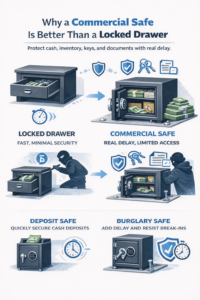
A locked drawer is better than nothing, but it rarely adds meaningful delay. For most businesses, the foundation of stronger cash handling security is a commercial safe selected for your workflow.
Safes matter because they change the timeline of a theft. In a robbery, speed matters. In internal loss, access and anonymity matter. A properly selected, professionally installed safe reduces how long cash is exposed and limits who can retrieve it. Many businesses also use safes to protect critical keys, controlled inventory, and sensitive documents.
Operationally, you get the best results when deposits are easy for your team and retrieval is limited. Deposit-style options can let staff secure cash quickly without opening the main compartment, which reduces handling time and helps prevent “I will do it later” habits during busy periods. For higher value storage, burglary-resistant models add more delay, especially when placed and installed correctly.
Placement and installation matter more than most owners expect. A safe should support workflow without being obvious to customers, and it should be properly anchored where appropriate so it cannot be removed quickly.
Tighten access so cash handling stays controlled as your business changes
Access spreads over time. Keys get copied. Spares disappear into drawers. Turnover happens. Managers change. A setup that felt controlled last year can quietly become wide open, which is why access discipline is a core part of cash handling security.
At minimum, you want clear key accountability: who has what, why they have it, and what happens when roles change. Reducing the number of master keys and restricting duplication can eliminate a lot of long-term exposure.
If you manage multiple managers, departments, or sites, access control can simplify your life because you can grant access by role and schedule, remove it quickly when responsibilities change, and maintain a record of entry activity. That record helps you resolve questions faster without turning it into a drawn-out investigation.
Use cameras to support cash handling security, not just “coverage”
Many owners have cameras, but fewer have the right visibility where it matters most for cash handling security: registers, cash counts, safe approaches, and the paths between them.
The goal is not more cameras. The goal is clearer answers. You want video surveillance that helps you identify who was involved, understand what led up to an event, and verify what happened during key cash handling moments.
That comes down to placement, lighting, and retention. If you cannot clearly see faces and hands during cash counts or deposits, or if footage is overwritten before you notice a discrepancy, the system will not support you when you need it.
Add response capability with alarms and monitoring
Cameras are great for review. Alarms tell you something is happening now. A commercial alarm system adds an extra layer to cash handling security after hours by detecting intrusion at entry points and interior zones, then triggering an alert and response workflow.
The key is designing zones around how your building actually works so the system is reliable and actionable. Monitoring adds structure when no one is on site and helps reduce dependence on someone noticing later. When alarms and cameras work together, you get clearer information during an event: what triggered, where it happened, and what video shows around that time window.
Make cash handling security sustainable with simple routines
The best cash handling security plan is the one your team can follow on a busy day. You are aiming for fewer steps, clearer responsibility, and fewer workarounds.
In practice, this often means keeping less cash exposed, using consistent deposit routines, limiting back-office access to roles that truly need it, and documenting exceptions so small issues do not become big distractions. The point is not paperwork. It is reducing gray areas.
American Safe Inc. helps commercial businesses across the South Bay, Peninsula, and East Bay strengthen cash and asset protection by integrating safes, key control and access control, surveillance, and commercial alarms with monitoring into one cohesive approach. To discuss options for your site, request a site assessment, talk with a security specialist.
Key Takeaways
- Strong cash handling security focuses on the moments when cash moves, not just general security.
- A properly installed safe reduces cash exposure time and adds real delay.
- Key control and access control prevent access from spreading as staffing changes.
- Camera placement and retention support accountability during deposits and cash counts.
- Alarms and monitoring add response capability, especially after hours.
- Simple routines make cash handling security consistent on busy days.