
Access Control in San Jose: A Practical Guide for Commercial Properties

If you manage a building in San Jose, access control is rarely just a security project. It is an operations decision that shows up in real moments: a new hire who cannot get in on day one, a vendor who needs after-hours access, a door that gets propped up because the process is inconvenient, or a lost key that turns into an urgent re-key.
Most teams are trying to keep people safe and keep the building moving. You want employees and tenants to feel welcomed, but you also need clear control over staff-only areas, deliveries, and sensitive spaces. And when something happens, you need answers that are specific and defensible, not guesses.
Modern access control gives you a cleaner way to manage who can enter, when they can enter, and what happens when something goes wrong. Done right, it reduces rekeys, improves accountability, and makes multi-site management far easier.
What access control actually means
Commercial access control replaces or supplements traditional keys with managed credentials. Those credentials can be key fobs, cards, PINs, mobile credentials, or combinations depending on the door and the risk level.
The day-to-day value is simple. Instead of changing locks when access needs to change, you update permissions.
When San Jose businesses typically upgrade
Most commercial teams start looking at access control when one or more of these issues show up:
- High turnover or frequent tenant changes
- Too many keys in circulation and no clean way to track them
- Vendors need after-hours access, but you cannot supervise every visit
- Recurring door propping or tailgating concerns
- Incidents where you need to know who entered a space and when
- Multiple locations that need consistent policies
In busy corridors like South Bay, Peninsula, and East Bay operations, access control is often as much about reducing admin time as it is about security.
Where access control makes the biggest impact
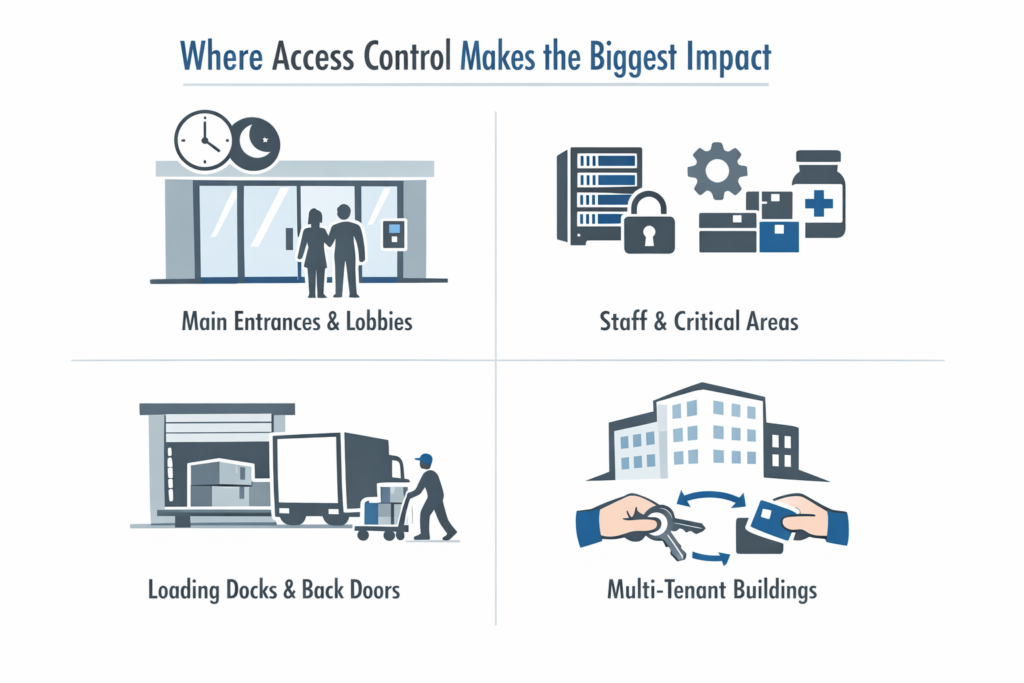
Not every door needs the same solution. The best approach is to start with doors that create the most risk, liability, or operational friction.
Main entrances and lobbies are common starting points, especially where you want controlled entry after hours or better visitor flow. Staff-only areas and critical rooms are also high value, like IT closets, mechanical rooms, inventory cages, medication storage, or records rooms. Back doors and receiving areas are another frequent priority because they are common entry points for vendors and are often involved in loss events.
If you manage a multi-tenant property, access control can also help reduce the constant cycle of rekeys and handoffs at move-in and move-out.
Choosing credentials: what works best in real life
Card and fob systems are still popular because they are simple and familiar. Mobile credentials are growing fast because employees do not want another item to carry, and offboarding becomes immediate.
PINs can work for certain doors, but they require strong policies. Shared codes are a common weak spot because they spread quickly and are rarely updated consistently.
A practical setup is often a mix: mobile or fob for regular staff, time-limited credentials for vendors, and stricter controls on high-risk rooms.
The benefits that matter to operations teams
Access control improves more than security.
You can deactivate credentials instantly when staff leave or vendors change. You can set schedules so doors unlock only during approved hours. You can reduce rekeys and keep consistent access policies across sites. When incidents happen, you have audit trails that show when doors were opened and which credentials were used.
For facility teams, that usually translates into fewer emergencies, fewer service calls driven by lost keys, and faster investigations.
Why integration matters
Access control is most effective when it works as part of one system, not another disconnected tool.
When access events connect with cameras, you can verify what happened without hunting through footage. When it connects to alarms, you can improve after-hours protection for restricted areas. This is where the traditional plus digital approach becomes a real advantage: door hardware and locksmith support, plus modern access control, plus surveillance and monitoring, all working together.
Avoid these common mistakes
The biggest mistake is treating access control like a product purchase instead of a workflow decision. If you do not define who needs access, when they need it, and who manages changes, the system becomes frustrating.
Another common issue is starting too big. If you try to upgrade every door at once, costs and complexity rise quickly. A phased approach usually wins: start with high-impact doors, prove value, then expand.
Finally, do not overlook the door itself. If the hardware is failing, the door does not latch reliably, or the frame is weak, even the best electronic system will struggle.
What to expect from a site assessment
A good assessment should look at doors, hardware condition, traffic patterns, and risk points. It should also map out who needs access, what schedules make sense, and how you will manage credentials across your team.
The outcome should be a plan that fits your building and your staffing reality, not a one-size-fits-all recommendation.
Talk with a security specialist
If you are planning access control in San Jose, American Safe Inc. can help you design a practical system that fits how your building operates. We support the full ecosystem: door hardware and locksmith services, access control, surveillance, and commercial alarms and monitoring.
Key takeaways
- Access control reduces rekeys and improves accountability
- Start with high-impact doors: main entry, staff-only areas, back doors
- Choose credentials based on how people actually work
- Integrate access control with cameras and alarms for faster incident response
- Phase the project to keep rollout simple and cost-effective